


Here’s what you could be paying to run your appliances and some ways you can save on your energy.
How much is the average electricity bill in the UK?
What you pay for energy depends on your usage and who you share your home with. It could also vary depending on where you are in the UK, and the type of appliances you have.
For example, some freezers are more energy efficient than others.
But on average, Ofgem estimates that an average British household uses around 9,500kWh of gas and 2,500kWh of electricity per year.
That’s about 792 kWh for gas and 208 kWh for electricity per month.
Ofgem has also estimated what a low and high energy user might use per year in gas and electricity:
- Low - 6000 kWh of gas, 1,600 kWh of electricity
- High - 14,000 kWh of gas and 3,800 kWh of electricity
Remember, everyone uses different amounts of energy - the more you use, the more you'll be charged.
To calculate the average bill for a low, medium and high energy user, we’ve based our prices on the current price cap rates (the cap is set at £1,8663 until 30 September 2026). This is usually the tariff that you’re put onto when your fixed term deal ends. Here’s what the average energy cost for different energy users could look like per month and year.
| Usage type | Average annual cost for gas and electricity | Monthly average cost for gas and electricity |
|---|---|---|
|
Low
|
£1,172.30
|
£97.69
|
|
Medium
|
£1,663.84
|
£138.65
|
|
High
|
£2,333.12
|
£194.43
|
*Based on Ofgem’s typical energy usage table for low, medium and high usage households.
We see here how the annual cost for a medium household on dual fuel would be rounded up to £1,664, which closely matches the current Ofgem price cap for a typical household.
Energy appliance usage specifics
How much energy does it take to boil a kettle?
Based on using a kettle for 15 minutes a day - this might be higher if you’re a caffeine fiend - a kettle could use around 24 kWh per month.
On a standard variable rate tariff that works out at £6.27 per month.
One way to reduce this cost would be to cut down on your tea and coffee intake - which is easier said than done. Or only boil as much water as you need.
By only boiling as much water as you need, the Energy Saving Trust estimates you could save around £10 per year. (£12 in Northern Ireland)
You can buy ‘one cup’ kettles that let you brew a single cup, helping you save even more.
How much energy does it take to run a tumble dryer?
A tumble dryer used by a family of 4 every week could use a total of 48 kWh per month. On a standard variable rate tariff, this could cost around £12.53 per month.
If you can, try air drying your clothes (or dry them outside if possible). You could save around £50-60 a year if you stop using your tumble dryer altogether.
How much electricity does a washing machine use?
Four weekly washes for a family of 4 could use around 8 kWh of electricity, working out at £2.09 a month.
It’s hard to reduce your weekly washes, particularly if you have a family. But if you can, try cutting down on 1 wash per week and reducing your washing temperature from 40°C to 30°C.
You might save around £30 per year by doing this.
What do energy ratings mean and why are they important?
One way to potentially save energy and your bank balance from the outset is to buy an energy-efficient appliance.
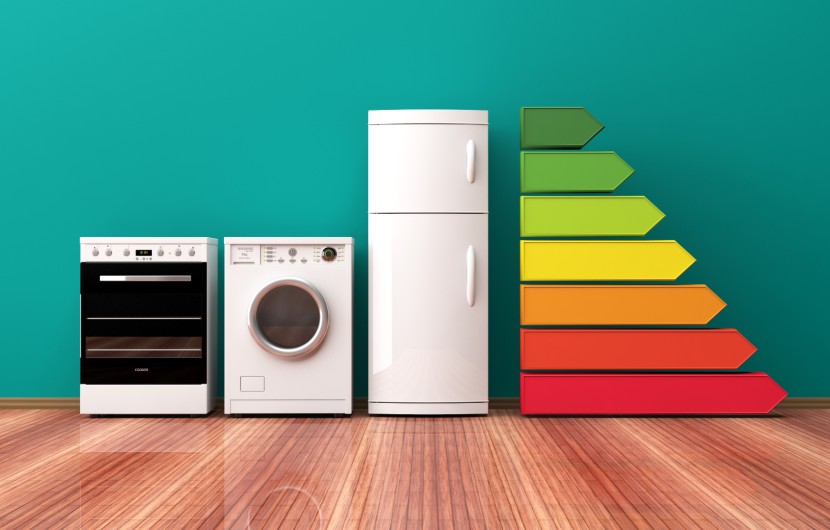
When you buy a new appliance, it normally has a label telling you the energy rating. The energy ratings changed in 2021. Instead of using A+++ to E, the new scale runs from A to G.
The new scale gives a more accurate reading of the energy efficiency rating of appliances.
At the moment, the new energy efficiency scale applies to refrigerators, washing machines, washer-dryers, TVs, displays, tumble dryers and dishwashers. For other products such as ovens, the new label should be introduced when new or revised UK regulations come into force.
But what do the energy efficiency ratings actually mean? Well it turns out that for your wallet, it means quite a lot.
| ITEM | KWH PER MONTH | COST PER MONTH (£) STANDARD VARIABLE TARIFF* |
|---|---|---|
|
Air con (8 hours per day)
|
288
|
£75.20
|
|
Electric heater (2 hours per day)
|
60
|
£15.67 |
|
Washing machine (weekly washing for family of 4)
|
8
|
£2.09 |
|
Kettle (15 mins per day)
|
24
|
£6.27 |
|
Tumble dryer (weekly drying for family of 4)
|
48
|
£12.53 |
|
Fridge freezer
|
17.2
|
£4.49 |
|
Games console (4 hours per day)
|
21.6
|
£5.64 |
|
43” LED smart TV (5 hours per day)
|
10.7
|
£2.79 |
|
Laptop (5 hours per day)
|
4.2
|
£1.10 |
|
Microwave (10 minutes per day)
|
4
|
£1.04 |
|
Vacuum cleaner (2 hours a week)
|
4
|
£1.04
|
|
Hair dryer (5 minutes per day, 4 times a week)
|
3.33
|
£0.87 |
|
Lawnmower (once a week)
|
3
|
£0.78 |
|
Hair straighteners (5 minutes per day, 4 times a week)
|
2.46
|
£0.64 |
How to lower your appliance energy cost
As you can see, the biggest costs are typically on managing the temperature of your home. If you rely on air conditioning during the summer, you can clearly see the massive amount of energy used by doing so – equally, electric heaters are also pretty pricey.
When you add this to the cost of running your kettle, laptops, TVs, washing machines and hair straighteners, it can all contribute to a pretty big sum!
It might sound obvious, but you could easily save energy by:
- Keeping the doors shut and using draught excluders in the winter
- Opening a window if it’s summer and the weather is hot
- Checking for draughts from your window
Our home heating hacks can give you some simple, cost-effective ways to keep your home toasty too.
For more ideas of how to pay less on your gas and electricity bills, read our energy efficiency guide. And bear in mind that if you work from home, the extra hours spent in the house, which would normally be spent in the office, also push up your annual energy bills. So if you’re allowed back into your office, potentially working there for a few days a week could mean a saving.
If you run your business from home, and more than 50% of the energy you use is for business purposes, it’s worth considering a business energy account.
Can I switch energy providers?
Yes, there are deals available to switch to - if you haven't switched for a year or more, you can almost certainly save money by signing up to a fixed deal. Click here to get started.
Get personalised electricity deals straight to your inbox




 cookie usage