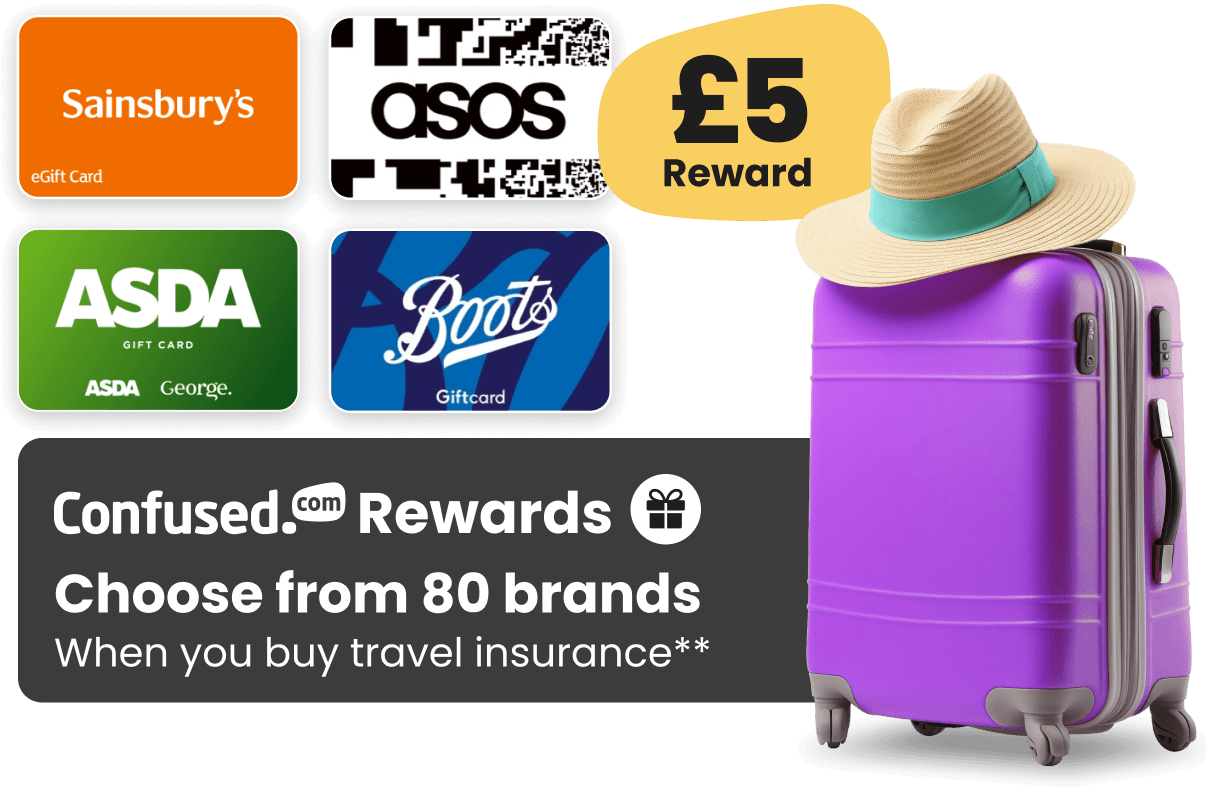






Rewards+ icon Get £5 to spend with up to 80 brands when you use Confused.com**
  1. Home
  2. Travel insurance

Travel insurance

Compare cheap travel insurance quotes from £2.802

Retrieve quote
Image of woman walking out of mobile phone with a suitcase and available rewards around her

1Correct as of February 2026
2The cheapest price for a single-trip travel insurance policy. Based on 1 adult aged 30 with no pre-existing medical conditions, travelling to Spain for 3 nights. Confused.com data, January 2026.

Trustpilot logo
Confused.com rated Excellent - 4.3 out of 5

We compare 46 trusted travel insurance companies1 to find you the best deals

Find the right travel insurance for you

There's 3 main types of travel insurance to choose from. Simply select the type you need when you get a quote.

Travel insurance icon

Single-trip travel insurance

Get cover for one holiday, with policies typically covering trips lasting up to 120 days. Cover you, your family or your group.

Multi-travel icon

Annual travel insurance

Get travel insurance for all the trips you're planning to take in the next 12 months. Choose from European or worldwide cover.

Travel backpackers icon

Backpackers travel insurance

Find a policy that'll cover you for up to 18 months while you explore multiple countries. This works for groups or solo travellers.

How much is travel insurance?

Single trip

£2.802

Annual cover

£8.453

Backpacker's insurance

£23.234

Travel insurance costs as little as £2.803 for a basic, single trip policy according to Confused.com data.

But exactly what you pay is based on a range of factors, like:

  • The type of policy you take out
  • Where you’re travelling to
  • How long you’re staying for
  • Extra cover you add to your policy
  • Your age
  • The number of people on your policy
  • Any medical conditions you have

To see exactly what you’ll pay for your holiday insurance, why not compare quotes? It’s quick, easy and free.

3The cheapest price for a European annual travel insurance policy. Based on 1 adult aged 30 with no pre-existing medical conditions. Confused.com data, January 2026.
4The cheapest price for a European backpacker travel insurance policy. Based on 1 adult aged 30 with no pre-existing medical conditions, travelling for 1 month. Confused.com data, January 2026.

Get £5 to spend with up to 80 brands when you buy**

Make your escape even better with Rewards+. Buy travel insurance and get a £5 reward to spend with up to 80 of your favourite brands. The choice is yours!

It's simple: get your quote, buy any policy, and claim your £5 reward in the Confused.com app.

How to claim

**Rewards available with qualifying purchases. App only. Maximum claim limit. Travel insurance policy must cost a minimum of £4.99 to be eligible for a reward.  T&C’s apply.

What does travel insurance cover?

Tick

Travel insurance usually covers:

  • Medical treatment costs: The cost of any emergency treatment you need while on holiday.
  • RepatriationThe cost to fly you home if you’re too ill to travel normally.
  • CancellationsIf you need to cancel due to things like ill health or bereavement, most policies will cover the cost.
  • Lost baggageIf your baggage is lost, stolen, damaged or destroyed most policies will help cover the cost of replacement.
  • Lost passportsIf you lose your passport, travel insurance policies will typically cover the cost of getting you a new one.
  • Cancelled flights: If your flight is cancelled, or you miss an excursion due to things like natural disasters causing travel disruptions, your policy will usually cover the cost.
  • Legal costs: Most policies will help with certain legal costs if you're involved in an incident that hurts a third party or damage their property.
Cross

Travel insurance doesn't usually cover:

  • Travelling against FCDO advice: If the government advises against travel to a country and you go anyway, your policy won’t cover you while you’re there.
  • Undeclared pre-existing medical conditions: You won't be covered for any treatment you need for conditions you fail to declare.
  • Incidents involving drugs or alcohol: Policies won't usully cover these.
  • Early return: If you want to come home early, most policies will not cover the cost of your return flights.
  • Flight delays: These aren’t usually covered, but you may be able to claim compensation for delayed flights from the airline.
  • Changing your mind: Deciding you no longer want to go on hoiday won't be covered.
  • Extreme sports or activities: Things like skydiving or rock climbing are unlikely to be covered by a standard policy, but adventure travel insurance add-ons might cover you for these.

Travel insurance add-ons

Add-ons let you tailor your travel insurance to your needs. Simply select the ones you want when you get a quote.

Winter sports travel insurance icon black on white background

Winter sports insurance

Get cover for mountain rescue, lost ski passes and piste closures due to bad weather when you hit the slopes.

Mobile insurance icon

Gadget insurance

Protect your gadgets, like your mobile phone, tablet or camera, against loss, theft or damage while you're travelling.

Travel cruise icon

Cruise travel insurance

Find cover for missed ports, unused excursions, cabin confinement or being airlifted to hospital on-land.

Travel business icon

Business travel insurance

Get cover for a laptop, phone, company cash or other specialist business equipment you might take with you when travelling for work.

Looking for specialist travel insurance?

What our travel insurance expert says

"Spring and Autumn are popular times for city breaks and cruises, but don't assume the weather is always mild. Unexpected storms or heavy rain can cause travel disruption or damage to booked excursions. Ensure your policy includes 'travel disruption' cover for non-flight-related issues, and check the cover limits for any non-refundable bookings like concerts or events."

Alvaro Iturmendi - Confused.com travel insurance expert
Travel insurance expert Confused.com logo

Do you need travel insurance?

For a lot of countries, you don’t have to have insurance in place to travel there. But for others you’ll need it before you can get a Visa. Some recommend you have it in place due to the high costs of medical cover for travellers holidaying there.

Here’s a breakdown of the destinations you need travel insurance for, and some others where it’s highly recommended.

Fully comprehensive insurance icon

Countries where it's recommended:

  • UAE
  • USA
  • Canada
  • South Africa
  • Switzerland & Norway
  • Thailand
convicted icon

Places where it's mandatory:

  • Cuba
  • The Galapagos Islands
  • Iran
  • Russia
  • Nepal
  • Turkiye

Is travel insurance worth it?

Whether or not travel insurance is worth it is up to you.

But here’s two examples from the Association of British Insurers that show just how much a claim might cost without it in place:

  • A traveller injured themselves in a fall on a trip to France. The cost of treatment for their injuries was £80,000. The traveller’s GHIC card covered £64,000 of this, but this left £16,000 outstanding. Luckily, the individual’s travel insurance footed the bill.
  • Another individual needed medical treatment in the Canary islands for a lung condition. This led to a £67,000 medical bill after treatment costs and repatriation were factored in. The claimants travel insurer paid out the full amount.

Travel insurance is often affordable - especially compared to the cost of medical treatment abroad - which is why many holidaymakers see it as worth having.

And it’s not just about medical cover. It can also help if you need to cancel your trip or if your baggage goes missing.

How to get cheap travel insurance

Compare quotes with Confused.com

  • Shopping around to compare travel insurance quotes can help save you money. Just remember that the cheapest policy might not be the most suitable, so check your policy details too.

Avoid policy add-ons you don't need

  • If you're planning on doing any sports or activities during your trip, check your policy details to see what you're covered for before adding extra cover. Some might be included as standard, so you won't need to pay for extra cover.

Consider a joint travel insurance policy

  • If you're travelling with friends or family, it could be cheaper to get a joint policy rather than individual ones. Just remember that if you buy a joint annual policy, you might not be able to travel separately.

Choose the right type of travel insurance policy

  • If you travel regularly throughout the year, it might be more cost-effective to buy an annual policy, rather than several single-trip policies.

Travel insurance with medical conditions

If you have a medical condition, you should still be able to take out travel insurance. You’ll just need to tell your insurer about your condition from the outset.

Here’s some handy guides on getting the right cover for your condition:

Critical illness icon

Travel insurance for diabetes

You should find plenty of travel insurers willing to cover you if you have diabetes, though you may pay slightly more for your cover due to the increased risks your condition poses. Just make sure you declare your condition from the outset.

Pre-existing travel icon

Travel insurance for epilepsy

Most travel insurance policies cover epilsepsy. You may have to pay slightly more than someone without the condition due to the increased likelihood of you needing medical tratment abroad, but otherwise cover shouldn't be hard to find.

Life insurance PMI icon

Travel insurance for heart conditions

If you suffer with a heart condition, you should still be able to find travel insurance. Your doctor may need to clear you to fly before you can apply, but otherwise there should still be providers out there willing to insure you.

Pregnancy travel icon

Travel insurance while pregnant

If you're pregnant, finding travel insurance should be easy. Most providers will cover you and you shouldn't have to pay any more than if you weren't pregnant. If you have an existing policy in place, tell your insurer you're pregnant before you travel.

When should I buy holiday insurance?

Try and remember to buy travel insurance as soon as you book your trip. You can buy travel insurance at any time up to your departure date. But buying your policy early means you're covered in the lead-up to your trip. So, you can claim for things like unexpected cancellations if needed.

Looking to plan your next holiday?

Our holiday budget calculator can help estimate the cost of your next trip in just a few minutes

Why compare holiday insurance quotes with Confused.com

We make it easy to compare policies

It takes about two minutes to get travel insurance with us! We ask about six questions and search multiple quotes to find you our best deals.

Our customers rate us 4.3/5 stars

We helped over 250,000 customers buy their travel insurance last year, so why don't you join them? Read what our customers are saying about us on Trustpilot.

We're 100% independent

We're not owned by an insurance company, so we'll show you our best travel insurance deals based on your details, not who they're from.

Our customers say:

4.5 green stars

Confused.com scores a 4.3 out of 5 rating
based on 9485 reviews as of 14/10/2025

Trustpilot logo

Planning your next adventure?

Our travel destinations hub explores some of the best places to visit each season, including advice on the right level of travel insurance for your trip!

Frequently asked questions

Does travel insurance cover cancelled flights?

If your flight is cancelled, most travel insurance policies can cover the cost.

But in many cases, the airline will offer a replacement flight first.

If you need to cancel your flight for reasons like a medical emergency, your travel insurance will usually cover this too.

However, if your flight is cancelled because of scheduled airline failure (i.e. the airline goes bust), your policy may not pay out. In that case, you might be able to claim the cost of a replacement flight through other protection schemes, like the ATOL protection scheme.

Do I need travel insurance if I have an EHIC or GHIC?

While travel insurance isn't usually a legal requirement, we'd say it's worth considering. Your EHIC or GHIC card can give you access to state-level medical care in most European countries and the Schengen Area. But some countries can still charge for treatment, and you wouldn't be covered if your doctor decides you need to return home for treatment. Travel insurance can cover medical costs and repatriation, if needed.

Travel insurance covers you for other things too, not just medical treatment. For example, lost or stolen baggage and travel disruption or cancellation.

Does travel insurance cover car rental?

No, travel insurance doesn’t typically cover car rental.

You have a few options if you’re renting a car abroad though. In most cases, the rental company will insure the car for you. You’ll be given an excess amount you’ll have to pay in the event of an accident.

This amount is often fairly high - sometimes close to the value of the car. If you find this to be the case, car hire excess insurance might be a good idea. This allows you to claim for the cost of the excess if you do need to claim on the rental company's insurance.

Can I buy travel insurance if I'm already abroad?

You can buy travel insurance last minute, but there's often not a lot of choice and it's often more expensive. And you're not covered for anything that's happened before you bought the policy, for example, if you lost your luggage.

If you buy travel insurance when you're abroad, there's often a delay before the start of your coverage so that the travel insurance company can do fraud checks. You're not normally covered while they're doing this. That's why it's always best to consider buying insurance as soon as you book your holiday.

How do I make a claim on my travel insurance?

It depends on the type of claim you're making. But for most claims you'll need to:

  • Speak to your travel insurer as soon as you can, and the local authorities if it's that sort of matter. For example, if your belongings are stolen.
  • Gather evidence. For example, save your medical bills or collect crime details from the local authority.
  • Give your insurer as much information as possible. Generally, it's easier and quicker for insurers to assess your claim if you give them lots of information.

Do I need travel insurance for trips in the UK?

It's not a legal requirement, and probably not something people would think to buy, but UK travel insurance could come in handy. Particularly if you're catching internal flights or your trip is cancelled.

Top tip: Some travel insurers do stipulate that you need to be a certain distance from home, and be away for a minimum number of nights. So, it's worth checking the policy details of any cover you're considering, just in case.

How does travel insurance work?

Travel insurance can act as a safety net when you're travelling abroad and offer financial support. As long as you've stuck to the policy terms, it can compensate you for costs related to these things:

  • Lost or stolen baggage
  • Travel disruption because of unexpected bad weather
  • Cancellations in the lead up to your break
  • Medical costs if you get injured or ill while you're abroad
  • Repatriation if your doctor decides you need medical treatment at home

In some cases, you might have to pay a travel insurance excess. But your insurer usually takes this amount from the final claim.

You can choose from different types of travel insurance policy too, either:

  • Single trip - this covers just one trip
  • Annual travel insurance - this covers multiple trips throughout the year
  • Backpackers travel insurance - this covers you for a longer trip to a few different countries

If you need to claim, you should report it to your insurer as soon as the incident happens. You can usually do this via an app or over the phone. If you need to, you can claim for different trips on an annual travel insurance policy. And you don't need to buy a new travel insurance policy every time you go on holiday.

Does travel insurance cover pregnancy?

Yes, travel insurance usually covers pregnancy.

Most insurers won’t offer cover if you’re more than 37 weeks pregnant (32 weeks for twins), as the risk of going into labour is higher.

You generally don’t need to tell your insurer you’re pregnant unless you’ve developed a pregnancy-specific condition, like gestational diabetes or high blood pressure.

Travel insurance can cover routine maternity care and unexpected events, including unplanned labour. It does not cover giving birth abroad if that’s your plan.

Some airlines and cruise operators may not allow travel after 24 weeks, but this varies. If you try to travel beyond their limit and are refused boarding, your insurance may not pay out.

What is a travel insurance excess?

Travel insurance excess is an amount you agree to pay towards a successful claim. The excess amount is normally deducted from your final payout by your insurance company. There are two types of excess, compulsory and voluntary:

  • Compulsory or standard excess: Usually this excess is set by the insurer and varies depending on the claim. For example, you could pay £25 towards a claim for luggage, or £100 for medical expenses. Generally though, you could expect to pay between £50 to £250 per claim.
  • Voluntary excess: You set the amount of voluntary excess when you buy your travel insurance. For example, you could choose a voluntary excess of £150. Setting this at a higher amount can bring the cost of your travel insurance down overall. But you should set it at an amount you'd be able to afford if you needed to make a claim.

It's important to remember that you usually have to pay both of these amounts towards a claim. So make sure you set your voluntary excess to a price that you can afford. It's also worth checking excess amounts before making a claim, as in some cases your excess might be more than your total claim amount.

You can buy no-excess travel insurance, which can mean you don't have to pay an excess. It's usually more expensive than a standard travel insurance policy at around £11.715 compared to £2.80* for single-trip. And, for some claims, you might still have to pay an excess.

5The cheapest price for no-excess single-trip travel insurance. Based on 1 adult aged 30 with no pre-existing medical conditions, travelling in Spain for 1 week. Confused.com data, December 2024.

Can I extend my travel insurance policy?

Some travel insurance providers allow you to extend your policy, while others don’t. The best approach is to contact your insurer directly to find out what’s possible.

If your policy has already expired or you’re already abroad, you may need to buy a new policy. This can be more expensive and harder to arrange, so it’s best to plan extensions before your original policy ends.

Can I upgrade my travel insurance?

In most cases, yes, you can.

If you want to add extra coverage onto your policy, or extend it some other way, most providers will allow you to do this online - or through their dedicated app.

If they don’t allow you to do this online, give them a call.

Travel insurance guides

Important information

All insurance products exclude cover for known events. These are global events that can put you in danger and/or disrupt travel. The COVID-19 pandemic is an example of this. This exclusion applies if the event was declared as a ‘known event’ when you bought your insurance.

If you’re travelling to a place where there’s a known event, such as the ongoing conflict in Israel and the Occupied Palestinian Territories, you will not be covered by your travel insurance.

If you travel against Foreign, Commonwealth and Development Office (FCDO) advice or fail to comply with your destination's entry requirements, you won't be covered by any travel insurance you buy.

Confused.com’s Travel Insurance solution is provided by theIdol.com. theidol.com is a trading style of Investment Discounts On-Line Ltd and is authorised and regulated by the Financial Conduct Authority. Registered office; Investment Discounts On-Line Ltd, One Coleman Street, London, EC2R 5AA. Registered in England no: 04231834. theidol.com is part of the Legal & General group.

Our service is free and compares a wide range of trusted household names. Confused.com is an intermediary and receives commission from theidol.com if you decide to buy through our website which is based on a percentage of the total annual premium. We pride ourselves on impartiality and independence – therefore we don't promote any one insurance provider over another.

Cover from £2.80*

Get your quote