


Criminals are using ‘relay technology’ to access keyless cars and drive them away. But if you’ve got a keyless-access car, don’t panic.
Our guide explains why they could be vulnerable and some top tips to prevent keyless car theft.
Key takeaways
- Keyless theft works by picking up your key fob's signal from inside your home and letting the car unlock as if the key is right there. This is often done in under 30 seconds!
- The Crime and Policing Act 2026 now makes it a crime just to possess, make, import, adapt, or sell relay devices. Offenders could face up to five years in prison, an unlimited fine, or both.
- Storing key fobs in a Faraday pouch or metal tin costs very little and is one of the most effective preventative steps
- Thatcham rates new car models' relay-attack resistance through its NVSA (New Vehicle Security Assessment) programme - some models are significantly more vulnerable than others.
What is keyless entry?
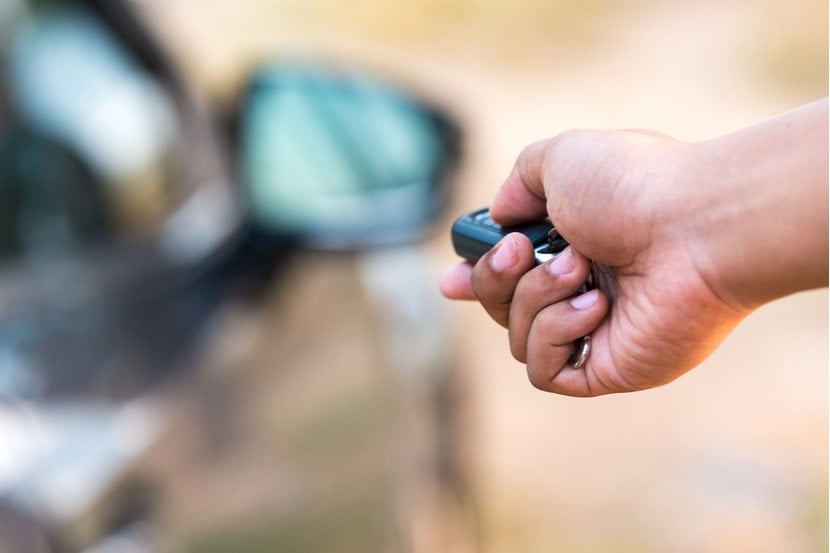
Keyless entry cars have a clever fob that ‘talks to’ your vehicle when you’re in range.
The fob contains an identity chip, which emits a code, or series of codes, that are picked up by the car. These signals work over short ranges, usually less than 5 metres.
You don’t have to physically put your key in the ignition to start driving. Instead, you just need to have it somewhere on your person to get into your car and drive away
This is much easier than rooting around in your bag, or trying to remember which pocket you put your key in. But it could put you at risk of keyless entry car theft.
Clever criminals have found new ways to target this technology and steal your car. This means it’s critical you take the right precautions to keep your car ‘key’ safe and prevent keyless car theft. If you're buying a used car and want to know the best way to check if a car is stolen, you can use reliable online checkers from the DVLA and HPI.
What is keyless car theft?
Keyless car theft is where thieves use so-called ‘relay attacks’ to steal your car without gaining access to your keys.
How does keyless car theft work?
Keyless entry car theft involves thieves working in pairs to steal cars that are parked close to their owner’s home. One stands outside with a special device that remotely receives a signal from the key fob. The other stands next to the vehicle with a second device that receives a signal and unlocks your car.
The thieves are then able to quickly get into your car and drive away while you remain totally oblivious to what’s been going on.
In some cases thieves can steal your car in less than 60 seconds.
Are keyless entry cars safe?
While relay attacks are becoming increasingly common, not every keyless entry car is at risk, and some might be more secure than others.
When choosing a car, consider ones with better security measures. This includes upgrades like motion sensors, which are used by Audi, BMW, Ford and Mercedes-Benz.
Land Rover has fitted some of its cars with ultra-wide-band radio technology. This is designed to transmit over a wide range of frequency channels so that thieves can’t trace the code.
If you have the kind of fob where you have to press a button to unlock your car, then you’re not at risk from relay theft at all.
Keyless entry car theft prevention
Keyless car theft has risen sharply from 13% of car theft incidents in 2019 to a peak of 57.6% in the year ending March 2024. That percentage eased slightly in 2025 to 46.7%.1 These alarming figures show how important it is to safeguard your car against these types of attacks.
If your car is one of the more vulnerable makes and models, then don’t worry. There are a lot of steps you can take to prevent keyless entry car theft.
If you want to protect yourself from keyless entry car theft and save yourself a car insurance claim, there are sensible precautions you can take.
Storing your electronic keyless car fob in a Faraday pouch
Faraday pouches work by blocking your car key signal, which prevents would-be thieves from stealing your car while you sleep. You can usually pick a decent one up for as little as £5. You might also see them called signal blockers.
Make sure you test to see if your pouch works. You can do this by putting the key in it and walking up to your car and checking if it unlocks.
Faraday pouches have a metal lining to block the signal. So, you could try keeping your keys in a metal car key box - a biscuit tin should do. But again, check it works before you rely on it.
Check your owner's manual to see if it can be switched off completely
If it can, make sure the fob is switched off every night when your car is most vulnerable to keyless entry car theft. It might also be worth switching the fob off in the day for extra peace of mind.
According to data from Tracker UK, keyless car theft accounts for an unprecedented 93% to 94% of all vehicles recovered by the company.
Keep fobs, including spares, away from doors and windows
Think about the safest place to keep car keys at home. The further away the fob is, the less likely the thieves are able to pick up the signal. This includes keeping your keys away from the front door, back door or windows.
Park in a well-lit area and make sure there are no valuables on display
You don’t want to make your car even more attractive to criminals. Always park in a garage if you have one. Failing that, consider lights and motion sensors outside your property to deter thieves.
You might also want to park defensively - as close to your house possible - to make access to the car difficult.
When buying a new car, ask if you can get a fob with a motion sensor
The motion sensor detects when the fob has been stationary for a while, which triggers sleep mode. During sleep mode the fob no longer responds to the relay signals, protecting the vehicle from relay attack. Full functionality is restored when the owner moves the key.
Some manufacturers, such as Ford, offer a software update that installs the sleep mode onto a new key.
If you’ve got an older car, it’s worth checking whether you can update your fob with a motion sensor.
The National Police Chiefs’ Council Lead for vehicle crime, Deputy Assistant Commissioner Graham McNulty, says:
“Part of the reason for the recent increase in vehicle theft is the rapid development in technology.
“The significant reductions in vehicle crime in the 1990s were achieved by police working with manufacturers to ‘design out’ crime with innovations like immobilisers, alarms and central locking. This approach is as valid today as it was then.”
Immobilisers are electronic devices that prevent the car from being started unless the proper key is used. Although it won’t stop criminals trying to break into your vehicle, they should prevent your car from being stolen.
Although seemingly obvious, it’s worth taking an extra 30 seconds to double-check your car is locked. Even if you’re only leaving it for 2 minutes while you fill up at the petrol station.
Traditional methods like steering, gearstick and handbrake locks also act as a visual deterrent for thieves, as well as adding an extra layer of security.
The new law on relay theft devices
The UK's Crime and Policing Act 2026 makes it illegal to possess, import, manufacture, adapt, or sell electronic devices used in keyless vehicle theft. If found guilty, you could be looking at a five-year prison sentence, an unlimited fine, or both.
The current law targets both supply and possession, making it a meaningful step towards stopping relay car theft in its tracks. But be wary: the law doesn't mean that all existing devices have been removed from circulation.
New police powers to tackle relay theft attacks mean that police can now arrest and prosecute individuals simply for possessing these tools. They no longer need to prove that someone was actively in the middle of stealing a car.
[$article/expert-quote/expert-quote-keyless-car-theft]
Most vulnerable keyless cars
If you’re on the hunt for the safest keyless entry cars, then it’s worth shopping around and doing your research. One of the key things to look out for are motion sensors, which could significantly reduce the risk of your car being stolen.
But remember: any vehicle equipped with a keyless entry and start system is potentially vulnerable to relay theft.
To help, car security experts Thatcham conducted extensive research around keyless car entry theft.
In a 2020 round of testing, Thatcham highlighted the following models as recent examples of new cars that are vulnerable to relay attacks and offer poor security:
- Mazda CX-30
- MG HS Excite T-GDI
- Subaru Forester e-Boxer XE Premium
- Vauxhall Corsa Ultimate Turbo 100
Since then, Thatcham have changed the way they assess car security. The New Vehicle Security Assessment (NVSA) checks locks, alarms, immobilisers and digital access points. It also assesses whether the keyless system can be beaten by a relay attack or by coding a blank key through the OBD port.
Since September 2024, NVSA results have fed into Thatcham's broader Vehicle Risk Rating (VRR), which scores vehicles across five areas: performance, damageability, repairability, safety and security. The table below gives you a better idea of what those five areas include:
| VRR pillar | What it assesses | Scoring |
|---|---|---|
|
Performance
|
Speed, acceleration, and the effect of the powertrain on risk
|
1-99
|
|
Damageability
|
How design, materials and construction affect damage severity
|
1-99
|
|
Repairability
|
Ease and cost of repair; availability of a clear repair strategy
|
1-99
|
|
Safety
|
Active and passive safety systems, including crash-avoidance features
|
1-99
|
|
Security (NVSA)
|
Resistance to keyless relay attack, whether the OBD port allows blank-key coding, plus immobiliser, alarm, double-locking and wheel security
|
1-99
|
According to Drive.co.uk, the following car models have heightened security against relay attacks:
- Jaguar
- Land Rover
- Audi
- BMW
- Ford
- Mercedes-Benz
The consumer group What Car? also found that the Land Rover Discovery SD6 306 HSE’s ultra-wide-band radio technology was effective in preventing thieves from accessing the car.
Cars that didn’t have motion sensor technology were found to be more easily stolen in the What Car? testing. These included:
- DS 3 Crossback Puretech 155 Ultra Prestige
- Land Rover Discovery Sport TD4 180 HSE (2018 model)
In short, any keyless car without this security technology is particularly vulnerable to relay theft.
Which counties in the UK are most at risk of keyless entry car theft?
In the UK, keyless entry car theft is highest in London, which accounts for 28% of all England and Wales thefts.
According to the ONS, 121,825 vehicle theft offences were recorded in England and Wales in the year ending March 2025.1 This is a 13% rise, the highest in over a decade.
According to the RAC2, the theft hot spots in the UK are:
- London
- Birmingham
- Manchester
- Leeds
- Sheffield
- Coventry
- Wolverhampton
- Leicester
- Walsall
- Bristol
Will my car insurance cover keyless car theft?
Yes, you should be able to claim on your car insurance if you’re a victim of keyless theft. But you might find that your car insurance costs increase the following year.
Your car insurance policy might also require that you have all of your key fobs to be able to make a claim. If you're in doubt, check with your insurer to find out the exact terms of your policy.
Compare car insurance quotes
Are car manufacturers doing anything to prevent keyless car theft?
Yes, luckily some car manufacturers are taking important steps in preventing keyless car theft.
Kia, for example, gives car buyers a Faraday pouch called the KIASafe Pouch, while Ford Focus, Fiesta, BMW, Audi and Mercedes all now use key fobs with motion sensors. This makes them inactive after 40 seconds, preventing car thieves from getting a signal from it.



 cookie usage