
With technology evolving faster than ever - and changing everything from the way we work to the way we wind down after work (hello TikTok binges) - it’s only a matter of time before it upends insurance too.
But what might the future of insurance actually look like as tech continues to take over? And why should you care?
To answer that, we asked our team of in-house experts what car insurance changes they see coming down the road in 2026 - and how these could affect the way you cover your car.
In this first installation of the Future of Car Insurance, we take a look at their first prediction: parallax risk cover.

What is parallax risk cover?
It might sound like insurance jargon (and it is - for now), but parallax risk cover could be part of your policy before you know it.
While it isn’t being used by insurers - yet - the technology behind it already exists. And it isn’t as complex as the name might suggest.
Here’s an overview of the basic concept:
Parallax risk cover policies would tap into a trio of tech, using dashcams, data from your smartphone and telematics devices fitted to your car to give you a personalised driver score.
The lower your score at the end of the month, the cheaper your insurance for that month.
So, the idea is fairly straightforward.
How does parallax risk cover work?
But how exactly would it work?
In short, data would be sourced from three ‘viewpoints’, or sources.
These would be:
-
The driver’s view: This would be data pulled from a black box fitted to your car. It’d send information to your insurer about things like your average speed, the sharpness of your braking, and the time of day you tended to drive - similar to how black box policies work now.
-
The contextual view: This set of data would then supplement the info gathered by your black box. Using your personal mobile device, things like your location, the weather you were driving in and the traffic density would all be gathered to assess the riskiness of the road you’d be travelling on.
-
The proximity view: Finally, dash cams fitted to your car would analyse the behaviour of other vehicles around you. Getting too close to other drivers - especially risky ones - could bring your score down.
All this data would then be compiled to produce a ‘parallax score’. You’d be able to monitor this in real time as you navigated the road. Brake too sharply, and you might see your score shoot up. But stay just under the speed limit, and you could see it drop down.
At the end of the month, the lower your average parallax score, the lower your insurance costs might be.
How much could parallax risk cover save you?
But how much could this new tech actually save you? And is all that monitoring worth it?
As it’s yet to be used, it’s difficult to say for certain.
But based on current average car insurance costs - and the reduced risk to insurers that parallax risk cover poses - our experts have come up with some figures they think would be likely under a parallax-based policy.
Assuming a perfect parallax score is 100 out of 100, and taking into account the current average cost of car insurance is £735* a year (or £61.25 a month) here’s the savings they predict you might get, based on your score:
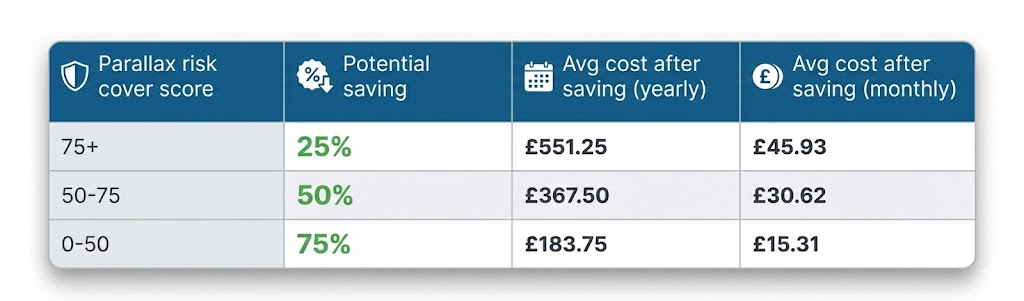
So not a bad saving!
*Confused.com price index data June-August 2025.
Parallax risk profiles: what are they?
So the mechanics of parallax risk cover are easy enough to grasp - a number of inputs are monitored and, based on those inputs, you’re assigned a score. The lower your score, the lower your insurance costs.
But as with all things insurance, it’s unlikely to be quite that simple. Or so our experts think.
They predict that your score might be multiplied by a second number. And this one would be based on your ‘risk profile’.
So what’s your risk profile? More jargon? Or a crucial part of the parallax puzzle?
Our experts think it would be based on your everyday driving habits. Things like the time of day you drive, how many miles you cover in a month, and whether you commute or just use your car socially would all feed into it.
Based on these factors, you’d then be bucketed into a category with other drivers who share your habits. Each of these ‘buckets’ would be assigned a value - based on the riskiness of the drivers within it - and that value would be multiplied by your initial parallax score.
This, finally, would determine exactly what you pay for your insurance.
A bit complicated? Maybe. But a smart way to keep things fair as your parallax score - determined largely by things outside of your control (like the riskiness of the roads you drive on) - would be multiplied by your personal risk profile score (based on things mostly within your control).
The result? Cover that’s personal to you without being prejudicial.
Parallax risk profile examples
Here are three example risk profiles our experts predict might be rolled out with early iterations of parallax risk cover.
The commuter
Commuters would be those using their cars to do just that - commute. They’d be classed as ‘middle risk. They’d be covering 1000 miles or more a month and would be mainly driving in the morning and evening. Their ‘risk profile’ score would likely be around 1.2, giving a commuter with an initial parallax score of 50 a revised score of 60. This would give them a potential saving of around 15% on the price of a policy, which against the average cost of car insurance today, would put their policy price at £625.
Night owls
- Driving time: night
- Risk level: high risk
- Mileage: 500 miles
- Risk profile score: 1.5
- Revised parallax score: 75
- Saving: 10%
Sunday drivers
| Metric | Data* |
|---|---|
|
Risk level
|
Low risk
|
|
Driving time
|
Afternoon
|
|
Mileage
|
300 miles
|
|
Risk profile score
|
0.5
|
|
Revised parallax score
|
25
|
|
Saving
|
35%
|
|
Average policy price
|
£478
|
*Confused.com price index data June-August 2025.
When will I be able to get a parallax risk cover policy?
As parallax risk cover is more of a concept than a concrete insurance product at the moment, it’s difficult to say.
But even so, our experts predict parallax risk cover could be rolled out as early as 2026. Though this would likely be done in phases.
Given that the South East tends to see the highest percentage of car insurance claims in the UK, it’s safe to assume that this region may see parallax risk cover policies rolling out before the rest of us.
Initial trials could see around 15,000 parallax policies introduced in the South East by July 2026, our experts claim, with a further 7,500 in place by December 2026.
So keep your eyes peeled.
Parallax risk cover: Confused.com's thoughts
From what you like on social media to what you pick up on the weekly shop - your habits are already being monitored.
And while this can feel intrusive at times - how do those social media ads always know exactly how to make you click? - it’s unlikely to slow down any time soon.
So why not use it to our advantage?
For the vast majority of us who navigate the road safely and sensibly, being tracked could lead to cheaper cover. And with average car insurance costs being so high, savings couldn’t come sooner.
For those already on black box policies, the jump to parallax risk cover might not seem so big. But for those of us with ‘unmonitored’ car insurance, it might take some getting used to.
But maybe that’s just the price we pay for cheaper cover.
 cookie usage