


20mph zones are now common across most residential areas in Wales and increasingly in parts of Scotland and England too, but as some councils start reversing them on specific roads, we look at what's changed since they were introduced.
Key takeaways
- In Wales, 20mph is now the default limit on most residential roads, and Scotland and England are bringing in more 20mph limits too.
- Some councils, including Newport, Cardiff and Rhondda Cynon Taf, appear to be changing certain roads back to 30mph.
- Welsh Government figures suggest casualties on 20mph and 30mph roads fell by around a quarter in 2024, but a full evaluation isn't due until 2029.
- 20mph limits are enforceable, and speeding can lead to a £100 fine and 3 penalty points, or a speed awareness course. Always look for the signs, because the default limit is different in Wales than in England and Scotland.
What's the difference between a 20mph zone and a 20mph limit?
They can look the same at first glance, but a 20mph zone and a 20mph limit aren’t the same thing.
A 20mph zone has physical traffic calming, like speed humps, chicanes or narrower roads. It starts with a zone entry sign showing a 20mph roundel. The idea is to make 20mph feel like the natural speed, so you don’t need cameras or enforcement to keep drivers slow.
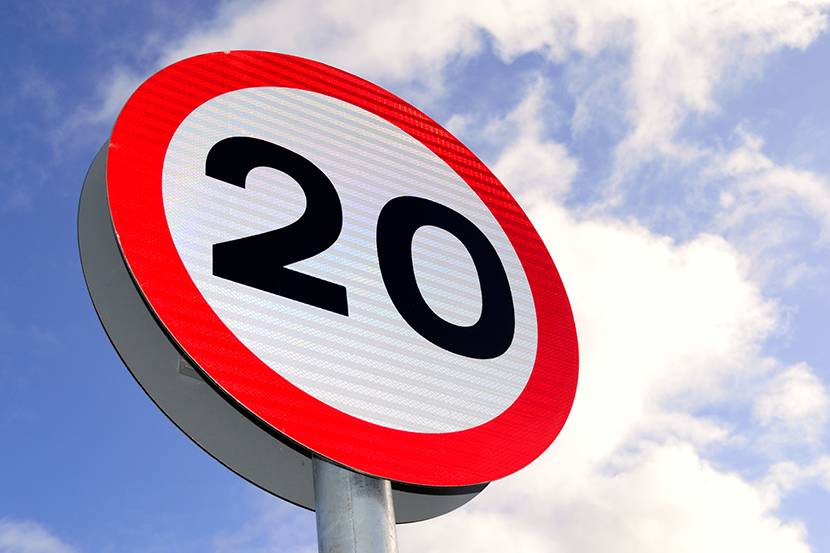
A 20mph limit is just a signed speed limit. There’s no traffic calming. Instead, 20mph roundel signs show where the limit starts and are repeated along the road. The Department for Transport explains more in its guidance on setting local speed limits.
Does seeing speed bumps mean you’re in a 20mph zone? Usually, yes. Speed bumps are common in zones but not in limits. But it’s the sign that tells you the legal limit, not the bumps. If you’re not sure, look for the sign.
What are the latest changes to the 20 mph zones?
Still confused about 20mph limits? You’re not alone. Councils are rethinking where they apply, and some roads appear to be switching back to 30mph.
Let’s start with Wales. Since September 2023, most residential roads have been 20mph by default. Over the past year, some councils have been checking whether that’s needed on every road.
Newport City Council asked residents what they thought and got over 3,500 responses. People put forward 335 roads for review. Only a few met the Welsh Government’s rules for exemptions, and the council proposed returning 16 of them to 30mph.
Cardiff has also looked again at its roads. Reports say four major routes were due to return to 30mph in August 2026: Newport Road (except outside St Illtyd’s school), part of Western Avenue, Ocean Way and Hadfield Road. Rhondda Cynon Taf has also carried out a review and planned to return 22 of the 26 roads put forward for consultation to 30mph.
This makes sense. One big complaint about the original rollout was that 20mph was a blanket rule, even on roads where it wasn’t really needed. Changing roads one by one seems to answer that.
Scotland, on the other hand, has been working to speed up its 20mph rollout. It aimed to have 20mph limits on suitable roads in built-up areas by the end of 2025/26, though progress on council roads appears to have been slower. Glasgow started a phased rollout in June 2026, covering about 3,800 streets in 6 phases, starting in Govan. Inverclyde is also bringing in 20mph limits on over 1,000 roads, with permanent limits to follow after an evaluation period.
Why did the government introduce 20 mph zones?
The Welsh Government brought in the 20mph default to make residential areas safer and improve people’s wellbeing. It applies to ‘restricted roads’. These are mostly roads with street lights, unless a council has made an exception.
When the policy was announced, the Welsh Government estimated that 20mph limits across Wales could mean, every year:
- 6 to 10 lives saved
- 1,200 to 2,000 casualties avoided
It pointed to earlier research showing 40% fewer collisions in 20mph areas than in 30mph areas. More recent Welsh Government figures say up to 9 lives and up to 98 serious injuries a year.
More than 3 years on, there’s now some real data to compare. Welsh Government figures suggest casualties on 20mph and 30mph roads combined fell by around a quarter in 2024, the first full year, compared with 2022. In the first 12 months, around 100 fewer people appear to have been killed or seriously injured. But a change in how one police force records collisions means those figures should be treated with some caution.
Other groups have looked at it too. Academics at Aberystwyth University wrote that collisions on 20mph and 30mph roads combined were down 23.5%, and casualties down 25.8%, in 2024 compared with 2022. Senedd Research found collisions on these roads fell faster in Wales than in England or Scotland between mid-2023 and the end of 2024, but says it’s still early days.
So it’s not settled yet. Transport for Wales says you need at least three years of before-and-after data for a reliable assessment, and the Welsh Government’s full evaluation isn’t due until 2029. People are split too. A BBC-commissioned poll earlier this year found more than half of people in Wales were against the limit.
The Welsh Government has also said the lower limit could:
- Make streets safer for children who are playing
- Improve safety in communities
- Improve health and wellbeing
It’s not the only change to encourage walking and cycling. In 2022, the Highway Code changed to protect vulnerable road users like cyclists, horse riders and pedestrians. Drivers must now give way to pedestrians crossing or waiting to cross at a junction, and leave at least 1.5 metres when overtaking cyclists at speeds up to 30mph.
The lower limits could also help reduce noise pollution.
Opinion is mixed. Supporters point to safer residential streets. Critics say some larger roads don’t need the lower limit.
Are the 20 mph zones enforceable?
Yes, they can be. 20mph zones and limits are enforceable across the UK. The penalties are the same as for speeding anywhere else: a fine, points on your licence and, in some cases, a speed awareness course or prosecution.
Wales shows how enforcement has changed. When the limit began, GoSafe and the Welsh police took an ‘engagement-first’ approach called ‘Operation Ugain’. Drivers caught speeding in 20 mph zones were offered a choice: go to a short roadside session run by the Welsh fire and rescue services, or take the points and a fine. Drivers well over the limit weren’t offered the choice. Reports suggest this option has since ended, so it’s worth checking the latest position with GoSafe.
If a speed camera catches you in a 20mph limit, you could be offered a speed awareness course. Or you could face a speeding fine of £100 and 3 penalty points. If you’re well over the limit, you might end up in court instead. See GOV.UK on speeding penalties.
“These 20mph changes are there for a good reason. Ignoring them could land you in hot water. “If you’re caught speeding, you could face a ticket, points on your licence, or have to attend a speed awareness course. If you get points on your licence, the lowest you could pay for your comprehensive car insurance is £766* on average. “Roads with 20mph limits should be clearly signposted. If you’re unsure, check your local council’s website for details on any changes.”What our motor insurance expert says


*Confused.com data, March-August 2026.
How can you tell if you’re in a 20mph zone?
There should be a sign at the start of the limit telling you it’s 20mph. But the rules aren’t the same everywhere.
In Wales, most roads with street lights no more than 200 yards apart are now 20mph by default. In England and Scotland, those roads usually still have a 30mph limit unless signs say otherwise. So always look out for the signs.
If you learned to drive a while ago, you might remember that lamp posts like these meant a 30mph limit. That’s still true in England and Scotland, but not in Wales.
Some drivers may also find the limits confusing, especially where the limit changes over a short distance.
Why are people tailgating me in the 20 mph zones?
Some drivers have reported tailgating in 20mph zones. That’s when a driver follows too close behind you. It could be because cameras or police don’t always enforce the limits. Or some drivers might just find the speed too slow.
If someone’s tailgating you, the advice is the same on a 20mph road or a 50mph road. Pull over when it’s safe and let them pass. Getting angry or pulling a face in your rear-view mirror won’t help - it could make things worse.
Will the 20 mph zones create congestion and increase my journey time?
Research cited by Transport for London suggests the effect on journey times is ‘negligible’.
TfL says journey times depend mainly on delays at junctions, not on how fast vehicles are going. It adds that journeys when roads are quieter, outside rush hour, may take slightly longer.
Are there plans to introduce 20 mph speed limits in England?
There are already 20mph limits in parts of London and Bristol. Bristol City Council introduced its limits from 2012.
Rochdale Borough Council has also been rolling out 20mph limits in phases, with the aim of making 20mph the default on residential roads across the borough.
Gloucestershire County Council is planning a phased rollout. It has secured almost £2.8 million, with the first projects due to start in 2026/27 as part of a four-year programme.
Some rural areas across the UK may have brought in 20mph limits too. There don’t appear to be any plans for a default 20mph limit in Northern Ireland.
It’s not just the UK either. Some places have brought in similar limits. Spain has a 30km/h limit in urban centres nationwide, and Helsinki in Finland has 30km/h limits on more than half its streets.
 cookie usage