


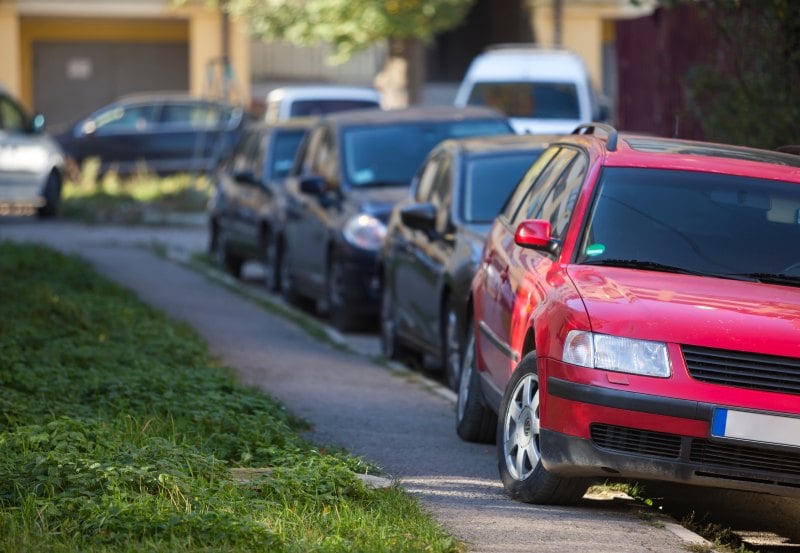
Pavement parking can put pedestrians at risk. Here’s what the rules say and how the UK’s pavement parking ban is progressing.
Key takeaways
- Pavement parking has generally been prohibited in London since the 1970s, while Scotland introduced a nationwide ban on 11 December 2023.
- In England, legislation passed in April 2026 provides for local authorities to introduce pavement parking bans, but this is not an automatic nationwide ban.
- Further legislation is expected to address enforcement against unnecessary pavement obstruction, although no confirmed timeline is available.
- In Wales, discussions are ongoing about how a similar approach could apply. In Northern Ireland, there is no general pavement parking ban, although local restrictions can apply.
- Pavement parking can obstruct wheelchair users, parents with pushchairs and people with visual impairments.
Is it illegal to park on the pavement?
It's generally illegal to park on the pavement in London, according to the Highway Code. It's also illegal to park on the pavement in Scotland, where a nationwide ban came into force on 11 December 2023.
In other parts of the UK, pavement parking restrictions can vary depending on local rules. In some cases, parking may be prohibited by signs or other restrictions, such as yellow lines.
If you've been caught parking on the pavement by the police, you could be charged with 'unnecessary obstruction of any part of the highway'. This is because parking on the pavement can be treated as a criminal offence if you're causing an obstruction.
But, according to Living Streets, enforcement is inconsistent because police resources are limited and the laws surrounding pavement parking can be confusing.
What are the changes to pavement parking in the UK?
Here's how the latest campaigns for each country are going and an update on the latest:
Scotland
From 11 December 2023, it's been illegal to park on the pavement in Scotland. You could get a £100 fine, reduced to £50 if paid within 14 days.
It's also illegal to park at dropped kerbs and to double park. This means parking next to a parked car.
The ban has now been in force for nearly three years, making Scotland a trailblazer among the UK's nations.
Living Streets said while the ban is a good step forward, the Scottish government need to "get it right" and that "blanket use" of the ban might not be the right approach.
Stuart Hay, Director, Living Streets Scotland, says:
"Mass exemptions seriously undermine the ban and will put people at risk if they aren't introduced following rigorous assessments and consultation. Ongoing promotion of the ban and engagement with communities is also vital to ensure the implementation is effective.
"Without sufficient enforcement capacity many groups including disabled people will feel badly let down. We want to see targeted and proactive action in known hotspots where pavements need to be cleared of obstructing cars."
Northern Ireland
In Northern Ireland, the police can issue a fine for a car that's causing a general obstruction. They can also fine a motorist if their car is blocking access to someone's home.
But there isn't legislation to stop cars parking on pavements. They'd be able to fine someone if there was an existing parking restriction in place, like double yellow lines.
The Department for Infrastructure can introduce pavement parking bans at any time. It's already done this in a few places where pavement parking has been a problem.
Wales
In Wales, the pavement parking task force was reinstated in 2022, and proposed implementing parking legislation by the end of 2023. This was delayed while councils focused on introducing 20 mph speed limits in residential areas.
Lee Waters, MS, then Deputy Minister for Climate Change, said in April 2023:
"We're asking a lot of hard-pressed local authorities at what continues to be a difficult time. I've listened to the feedback from leaders and decided to delay the consultation on pavement parking. This will enable local authorities to focus on the implementation and introduction of default 20mph speed limits in September 2023 and the work to prepare for bus franchising."
In February 2026, Cabinet Secretary Ken Skates told the Senedd that the Welsh Government endorses the UK Government's approach to tackling pavement obstruction and is in discussions with the UK Government about how it could apply in Wales. He did not commit to a ban, and no timetable has been confirmed.
England
After gathering evidence since 2020, the government published its response to the pavement parking consultation on 8 January 2026. Rather than introducing a national ban, it opted for a devolved approach, giving local authorities the power to introduce their own pavement parking prohibitions.
The enabling legislation, the English Devolution and Community Empowerment Act 2026, received Royal Assent on 29 April 2026.
This does not mean pavement parking is automatically banned everywhere in England. The Act is an enabling power, so regulations need to be made, and each local transport authority then decides which streets are covered and when enforcement begins. Secondary legislation is also still expected to follow, allowing councils to use uniformed civil enforcement officers to act against unnecessary obstruction of the pavement, though the Department for Transport has not yet confirmed a timeline.
Living Streets, which has campaigned on pavement parking for over 50 years, welcomed the legislation. Catherine Woodhead, Chief Executive, said:
"For too long, our streets have been no-go zones for people with wheelchairs, guide dogs and pushchairs."
She called on councils to use their new powers and urged the government to issue clear guidance to ensure consistent implementation across different areas.
Why can't I park on the pavement?
When you park on the pavement, you're blocking part of the pavement so pedestrians have to walk in the road to get around your car. This puts the pedestrian at risk.
It's even more difficult for people who have a disability, are elderly, or have young children, to pass cars parked on the pavement.
Stephen Edwards, director of policy and communications at Living Streets, said:
"We're regularly contacted by disabled and older people who feel trapped in their homes because there isn't enough room on the pavement for wheelchairs or mobility scooters.
"Pavements aren't designed to be parked on, and over time the surface can become uneven or cracked, causing trip hazards too."
What happens if I’m caught parking on the pavement?
You could get a PCN if you're caught parking on a pavement where it's not permitted.
If you're caught by the council, you'll get a penalty charge notice (PCN) from your local authority. The amount varies by area. Check your notice for the amount and the deadline for paying. The fine is often reduced if you pay early, but this depends on your local council's rules.
If you're caught by the police, you could be charged with the offence of obstruction and given a fixed penalty notice (FPN). Depending on the offence, you could also get penalty points on your licence. Leaving your car in a dangerous position could also lead to a conviction. Fines and penalties vary depending on the circumstances.
Our data suggests that the typical quoted price for annual comprehensive car insurance for a driver with one conviction is £752.25*, compared with £561.63* for a driver with no convictions.
You can appeal a PCN if you don't think it was warranted by contacting your local council. But FPNs can only be challenged through the courts, which could be expensive.
*Median annual quoted price, Confused.com comprehensive car insurance quote data, April to September 2026.
How to stop cars parking on pavements
If you spot a car parked on the pavement in an area where it's illegal, you can report it to your local council. You can find your local council's contact details using GOV.UK.
If you're in London, where there's a ban, call your council and ask if they can send a traffic warden.
But if you live somewhere where there isn't a ban, there's not much you can do about the parking itself, other than make your local council aware of the issue. If a car is causing an obstruction, you can also report it to the police on 101.
You could also try talking to your neighbour if they park on the pavement. They might not be aware of the problems they're causing and find alternative parking. If you don't know who the car belongs to, you could also try leaving a note on the car windscreen.




 cookie usage