


When you get a home insurance quote with us, we'll ask you, "What type of lock is on the main entrance?"
Having secure and robust door locks means your home is less likely to be burgled. This could result in lower insurance costs.
Here's how you find out what type of door lock you have, and which lock type is best for you.
What are the different types of door locks?
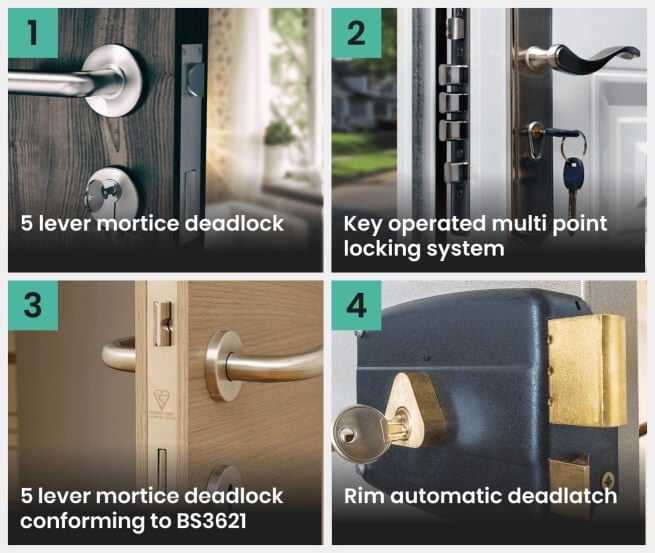
When you get a home insurance quote with us, you can select 4 main types of door locks. These are:
- 5 lever mortice deadlock
- 5 lever mortice deadlock (BS3621)
- Key operated multi-point locking system
- Rim automatic deadlatch with key locking handle
According to our data, the most common type of door lock is the key-operated multi-point locking system - around 66% of people selected this when they got a home insurance quote*.
Each of these lock types have their own benefits and suit different kinds of doors. They also offer different levels of security.
If you don't have any of these, choose ‘other lock type’ – and consider changing your locks to one of these 4 recognised types.
Let's look at each of these lock types:
5 lever mortice deadlock
This is a standard deadlock, offering moderate protection to your door. You can lock it from either side and is sometimes used with a night latch for added security.
You most commonly see these door lock types on timber doors. The 5 lever mortice deadlocks use a key to lock and unlock, so there’s less risk of accidentally locking yourself out of your home.
Pros:
- A step up from a 3 lever deadlock
- It can be 'keyed alike' - this means you can have 1 key for multiple locks
Cons:
- The door lock has been tested by the manufacturer only and doesn't meet British Standards
- Might not stand up to modern techniques used by burglars
How do I know if I have a 5 lever mortice deadlock?
You’re likely to have a 5 lever mortice deadlock if:
- Your door is made of wood
- The door doesn’t lock automatically when you close it
- You can see the words ‘5 lever’ engraved on the faceplate of the lock
5 lever mortice deadlock (BS3621)
This door lock type is the same as a 5 lever mortice deadlock.
The main difference is that the lock adheres to British Standard (BS) 3621. This means it meets the standards of the British Standards Institute as being secure against picking and drilling the lock.
This is the door lock of choice for many insurers. Some insurance companies insist you have this type of lock to get cover.
Pros:
- Meets strict British Standards
- Tested against lock picking and drilling
Cons:
- Only 1 locking point
How do I know if I have a 5 lever mortice deadlock (BS3621)?
- The door is made from wood
- A BS3621 door lock has a Kitemark on the lock’s faceplate.
- There should also be a serial number that starts in BS3621.
Key-operated multi-point locking system
A key-operated multi-point locking system bolts the door into the frame and locks at multiple points at the turn of a key. This type of door lock offers you a high level of security.
This door lock is common in more modern houses as you usually find it on patio doors made of UPVC.
As with the 5 lever mortice deadlock, these types of door locks need the key to lock and unlock the door. But the difference is a multi-point locking system locks the door at the top and bottom as well as the centre. This gives added strength to the weaker points of the door.
Pros:
- Multiple locking points
- Can be keyed alike, reducing the number of keys you need for your house
- Only needs 1 cylinder, which can you can change or upgrade
Cons:
- You need to lift the door handle to double lock the mechanism
- If you're unfamiliar with the locking method, you might not lock it properly
How do I know if I have a multi-point locking system?
There are a few key features including:
- The door is made of UPVC or composite
- The door locks at multiple points along its height
- You turn the handle up in order to lock the door
Rim automatic deadlatch with key-locking handle
If you have a rim automatic deadlatch, it should be mounted on the inside of the door.
The cylinder inside the lock is linked to the keyhole on the outside of the door, locking your door more securely from the inside.
You don’t often see dead latches on their own – they’re usually paired with a mortice deadlock for extra security.
The most common form of the dead latch is the night latch. With these, the door locks as soon as it’s closed. If you’re inside, you turn the latch to open the door. If you’re outside, you need the key. You often see these in flats and student accommodation.
- Pros:
- Easy to operate
- Door locks automatically on closing
Cons:
- Might require additional lock such as a 5 lever mortice to improve security
- Easier to lock yourself out by accident
How do I know if I have a rim automatic deadlatch?
Dead latches and night latches should be easy to spot if:
- Your door is made of wood – dead latches don’t work on UPVC or composite doors
- There’s another lock on the door as well - for example, a 5 lever mortice deadlock
- The lock is set into the surface of the door itself, rather than on the edge
How does having a good door lock impact my home insurance?
Yes - the more robust your security is, the greater your chances of getting cheaper home insurance. Here are the average home insurance costs for homes with each lock type:
| Lock type | Average home insurance cost* |
|---|---|
|
5 lever mortice deadlock
|
£153
|
|
5 lever mortice deadlock (BS3621)
|
£163
|
|
Key-operated multi-point locking system
|
£145
|
|
Rim automatic deadlatch with key-locking handle
|
£176
|
Why does the BS3621 lock have higher insurance costs than some other lock types?
The type of door lock your house has is only one of several factors that impact how much you pay for your home insurance. Other factors include:
- Your home's rebuild costs
- The total value of your contents
- Any previous claims you've made
It's possible that properties with these more secure locks have higher-value properties, or a history of break-ins. This could skew the average.
What’s the best lock type for a front door?
The best kind of lock to get is the 5 lever mortice deadlock (BS3621).
"Deadlocks tend to be harder to break into than other lock types, which is why many insurance companies recommend them.
"And BS3621 locks meet strict standards set out by the British Standards Institute. They're tested against break-in methods like lockpicking and drilling, so having this door lock proves to your insurer that your front door is secure.
"If your door can have one, I'd strongly recommend the 5 lever mortice deadlock (BS3621)."What our home & lifestyle insurance expert says


Are electronic and smart door locks worth it?
It depends on why you want them. Demand for electronic and smart door locks are on the rise as our homes get smarter and more connected.
If you want to incorporate electronic locks as part of your connected home setup, it could make things more convenient for you. The major risk with these types of door locks is that they can be hacked.
If you're hoping to get cheaper home insurance, smart locks might not be the answer. As the technology is still so new, electronic and smart locks are usually seen as a higher insurance risk than a standard door lock.
We don't ask about electronic or smart locks when you compare home insurance quotes with us. Instead, you'd need to select 'other' under the list of lock types.
And since these locks aren't generally approved by insurers, you could see your home insurance costs going up rather than down.
Compare home insurance quotes
*Confused.com data. October 2022 - September 2023. Buildings, contents and combined home insurance policies.



 cookie usage