Your breakdown insurance questions answered

woman broken down at roadside on phoneWith around 30 million cars on the road in the UK, breakdown cover is now a vast industry – certainly a lot bigger than it was way back in 1897 when the first recovery service was introduced.

But despite the huge range of services now available, many people still assume that breakdown cover is all the same. This is simply not the case. Protection can be as minimal or as comprehensive as you want – from simple roadside assistance to overnight accommodation abroad and your car repatriated following a breakdown abroad. The important thing to remember with breakdown insurance is, as with most things, you get what you pay for.

With that in mind, we’ve answered our most frequently asked questions about breakdown cover, so that you’ll know exactly what you’re paying for the next time you come to buy breakdown insurance.

1. What is breakdown insurance?

Breakdown insurance – also known as breakdown cover, roadside assistance, roadside recovery and roadside rescue – is a service offered to motorists which provides assistance in case their car breaks down. However, levels of service can vary considerably, but a common aim is to try and fix the car at the point of breakdown so that the car occupants are not left stranded by the roadside.

2. Is all breakdown cover the same?

Not at all. As with most things, you tend to get what you pay for. A cheap breakdown policy will generally offer just a basic level of cover, whilst an expensive policy will generally offer a comprehensive level of cover. And of course there’s cover available for all levels and for all budgets in between.

3. What are the different types of breakdown cover?

Different levels of breakdown cover are available to suit every budget. Breakdown companies often package their products into several standard levels of assistance, from basic to comprehensive, or you may be able to buy one of the levels and then customise it by adding features (such as relay, European cover or courtesy car) to suit your specific needs. Here are some typical examples of what’s covered under the different levels of breakdown cover:

Roadside Assistance

Basic, no-frills breakdown insurance is often called Roadside Assistance, and typically provides help in getting your car restarted at the roadside, transporting you and your car to the nearest garage if necessary, and little else. If you’re on a tight budget but definitely want the peace-of-mind afforded by breakdown cover, this could be the right option to go for. However, a tow to the nearest garage isn’t always included, and you’ll have to pay extra if that’s the case. Always check the policy small print to see exactly what you’re getting for your money. A typical Roadside Assistance policy includes:

  • No call out charges
  • Countrywide roadside assistance for breakdowns that occur more than a set distance from your home (typically a ¼ mile, though this can be further)
  • Fixing the broken down vehicle at the roadside. There won’t be a labour charge, but there will be a reasonable time limit set, after which the car will be towed to a garage. You will also have to pay for any parts that are required in fixing the car
  • Recovering the car to a local garage. If the car can’t be fixed roadside, it will be transported to a nearby garage. Distance limits apply – e.g. 10 miles – and you’ll have to pay extra if a long distance recovery is agreed. Check policy small print to see if the recovery also includes the car’s occupants
  • Basic roadside assistance may also feature a message service to inform people that you have broken down

Recovery/Relay

This more expensive option usually comprises all the benefits of a basic package, plus specific extras to ensure you and your car are returned to your home address, or onwards to any UK address (sometimes this is limited to the UK mainland). A typical Vehicle Recovery/Relay policy includes:

  • Vehicle recovery to any UK address
  • Driver and passenger transport to single address in the UK. A passenger limit will apply. (This can be up to seven passengers but check the policy small print)
  • Car and driver/passenger recovery to any single UK address if the driver becomes ill during the journey and there’s no-one else able to drive

Home Start/Home Call Out

As basic breakdown insurance won’t cover your car if it fails to start at or near (typically within a quarter of a mile) your home, this is a popular, though more expensive, breakdown option. A typical Vehicle Recovery/Relay policy includes:

  • Breakdown assistance should your car fail to start at home
  • Breakdown assistance should your car break down near your home (typically within a quarter of a mile)
  • Recovery to a nearby garage should the breakdown mechanic not be able to fix the problem

Onward Travel/Relay Plus

For an extra cost, this option – known by a variety of names – ensures you are not inconvenienced if your car is off the road by providing a replacement car or covering public transport costs. This level of cover will probably include all the benefits of one of the cheaper packages, plus:

  • Replacement car hire (for drivers over the age of 21 and usually for no more than three days maximum)
  • Insurance for the hire car (if not already covered under your own car insurance)
  • Public transport costs to get you to your destination (this can include air fare, though cost limits will apply)
  • Accommodation while the car is being fixed (typically for one night only in a B&B/hotel, and can cover all the car’s passengers at the time of the breakdown)

European Breakdown Cover

This upgrade is well worth considering if you intend to take your car on a long-haul journey to the continent. If you break down abroad, the bill for towing, repair, accommodation and repatriation can be very costly, and communication problems can also be very stressful. A European policy will provide an English-speaking helpline number for staff to sort out your problem for you. Typically, European breakdown cover can be bought as part of a breakdown package, or bought as an add-on to an existing policy (single trip or annual cover). This type of policy is often the most expensive, so make sure you definitely need that level of cover before signing up. Typical European breakdown policies include:

  • English speaking call center assistance
  • European roadside breakdown assistance (check the policy for countries that are covered)
  • Recovery to a local qualified repairer
  • Repatriation costs for you, your passengers and your car (limits will apply)
  • Emergency overnight hotel accommodation for you and your passengers (limits will apply)

4. What are the typical exemptions in a breakdown policy?

As well as knowing what you are getting with your breakdown insurance, it’s also vital to know what won’t be included. Some of the things often excluded are:

  • Parts (unless stated)
  • Labour costs exceeding the maximum set out in the policy (unless stated)
  • Claims exceeding a certain limit – such as the market value of your vehicle
  • Recovery following an accident; not even to a local garage
  • Claims after a mileage limit (stated in the policy) has been exceeded
  • Claims made not using the correct procedure (such as unauthorised work, services or expenditure on the vehicle)
  • Transport of any animal – such as horses or livestock - is usually not covered, though small domestic pets may be transported at discretion
  • Cover may not be offered if a breakdown service is called out for the same or a similar fault as that seen to in a recent call out for the same vehicle
  • Unlimited call-outs won’t be included, and each policy will have a maximum (e.g. five call-outs a year per person)

5. Does it matter who’s driving my car?

No. All breakdown insurance bought via Confused.com provides cover for a specific car, regardless of who’s driving it.

6. Will I be covered for any car I drive?

No. All breakdown insurance bought via Confused.com provides cover for a specific car, regardless of who’s driving it.

7. Will I be covered if my car breaks down at home?

This entirely depends on what level of breakdown cover you buy. If you purchase basic breakdown cover, then it’s unlikely, but if you buy a Home Start/Home Call Out type policy, or a more comprehensive level again, then you’ll be covered. If in doubt, check the policy details.

8. How can I save money on my breakdown insurance?

Be sure to shop around, looking for at least four or five quotes to make sure you are looking at the most competitive deals.

It’s also vital to keep an eye out for discounts – and there are usually plenty around. These can include any of the following:

  • Online discounts
  • Limited-period or seasonal offers
  • No claims discount systems for returning customers
  • Discounts for customers with new or relatively new cars

9. How long will I have to wait if my car breaks down?

This can depend on a number of factors, but the average response time is around 30 to 40 minutes. Obviously, if your recovery provider is inundated with calls, or if you’re trapped in the middle of no-man’s land, then this will make it trickier for you to be seen quickly.

It’s well worth asking each firm of their average response time when obtaining your quotes, as this is an important point of comparison. If you happen to be a single or pregnant woman then it is worth bearing in mind that you are likely to be seen more quickly.

10. What do I do in the event of a breakdown?

If you break down on the motorway

Without sounding too Dad’s Army, the first thing to remember is DON’T PANIC! Wherever you are, it’s important to recall that the safety of you and your passengers is your main priority. This means that, if you do experience a problem on the motorway, it’s always best to pull in at the next exit or service station; rather than the hard shoulder which should be used for real emergencies only.

However, if you do have to use the hard shoulder, here are some key things to bear in mind:

  • Use the hard shoulder to decelerate, before stopping as far to the left as is possible – preferably near an emergency telephone if you are able.
  • Turn your front wheels toward the grass verge.
  • Turn your hazard lights on, as well as sidelights if it is dark or poor visibility. DO NOT display a red triangle or any other warning device – traffic going past will be very fast-moving and this creates more risks than it prevents.
  • If possible, use the roadside emergency phone rather than your mobile – this will make it far easier to pinpoint your position.
  • Once you have received help and your vehicle has been repaired, return to the motorway using the hard shoulder as an acceleration lane – make sure you prevent merging with traffic until you are at a similar speed and there is a large enough gap to do so.

[For a more comprehensive list, check out these handy breakdown tips from Green Flag.]

NEVER use the hard shoulder to:

  • Stop for a break
  • Use a mobile phone
  • Check your route – make sure you know your route beforehand, and leave the motorway or pull into services if you do need to check

If you break down off motorway

If your vehicle breaks down on an ordinary road or carriageway, remember the following:

  • Leave your car in as safe a place as possible, away from traffic
  • Switch off the engine and put out any cigarettes
  • Switch on your hazard lights and if it is dark, or if visibility is poor, leave your sidelights on.
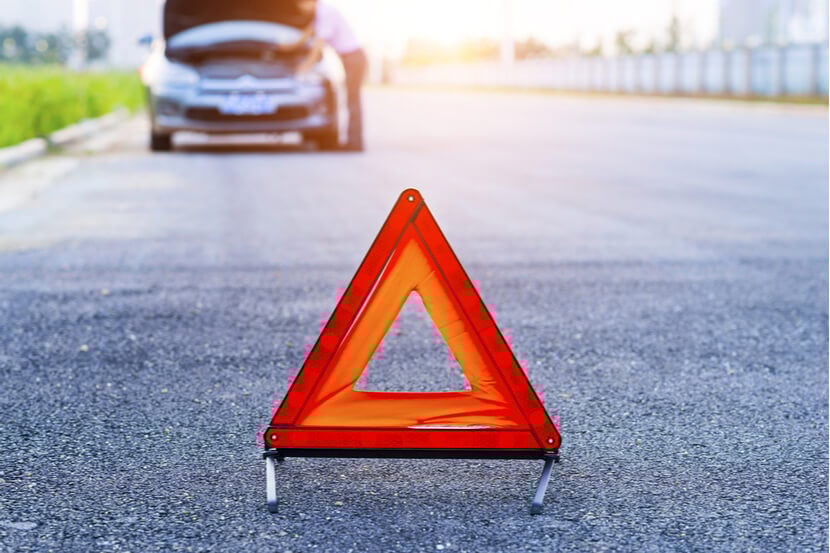
  • Display a red triangle if you have one.
  • Find the nearest telephone or use a mobile phone if it is safe to do so.
  • If you have had an accident, call the emergency services first, and then make contact with any witnesses.

11. Is my caravan or trailer covered?

You’ll need to check your policy carefully on this one. While a number of policies offer cover for a range of vehicles, including vans, motor homes and towed caravans or trailers, there may well be restrictions involved.

If your vehicle breaks down, most policies will also cover trailers and caravans up to a certain size and weight limit – however, it is worth noting that it if it is the trailer or caravan itself that breaks down, this is unlikely to be covered. Also, be warned; a number of companies will not offer Euro cover for caravans, so check with your provider.

12. What if I take the car abroad?

European Breakdown Cover

If you’re planning to take the car on to the continent then investing in European cover could be very worthwhile – particularly when you consider the costs involved if you fail to do so. If you were to break down abroad, this is rarely covered by your standard breakdown policy (or indeed your travel insurance). Indeed, repatriation costs for a vehicle can be rather steep – often running into the thousands.

A number of providers run pretty good standalone European breakdown cover, and with some it is even an add-on to your standard membership. As always, if it’s something you’re planning to do often, then it may well be worth consideration when choosing your provider.

The great thing about this sort of cover is that it usually includes recovery assistance through English-speaking staff – making the whole experience of breaking down abroad a great deal quicker, not to mention less scary. It usually also features full roadside and recovery assistance.

But – and as with all of these things, there is a ‘but’ – European breakdown cover can be a very expensive affair, sometimes even doubling your premium. As a result, it’s something that needs much consideration before taking the plunge.

TIP: For short-term trips abroad, it could well be worth looking into short-term European cover, offered by some UK insurers.

What level of cover do I need?

Definitions of cover levels and the services entailed vary between firms; however, there are certain options that are generally available. They include:

  • Roadside breakdown assistance
  • Emergency roadside repairs or tow to nearest repairer
  • Alternative transport (including public transport) costs to make sure you can continue your journey or get home
  • Emergency accommodation if you need to wait for repairs to be completed
  • Vehicle recovery to the UK if it can’t be repaired abroad; this is available up to the current market value of the car
  • Location of right-hand drive parts; though cost of parts is excluded

Thinking of buying? Things to consider:

  • How long are you going to be away?

Similar to travel insurance, how much you pay very much depends on the length of your trip. A number of providers offer single and annual trip policies, and it’s vital that you check with your provider before travelling how long you are covered for.

  • Is it more beneficial to you or your vehicle?

It’s important to think about whether you would prefer to have the driver(s) of the car covered, or the vehicle itself. The first option could be best if you are travelling alone or planning to regularly change vehicles and are unsure what to do in the event of a breakdown; whereas covering the vehicle itself might be more suitable if you’re planning to have a number of people drive the same car.

13. How is breakdown cover priced?

This is one of the most significant differences between providers, and understanding the different way in which each company prices their product could be a major factor in keeping costs to a minimum.

While some providers offer predetermined, vehicle based premiums, others instead calculate policy prices on a variety of criteria such as age of the policy holder, average annual mileage and how old your vehicle is.

Most breakdown cover offers an automatic system whereby the provider sends out their own patrol to either deal with a breakdown or to tow the vehicle to a local garage. However, for all the convenience of this there’s little escaping the fact that premiums can be fairly expensive as a result.

On a budget?Well there is one cut-price option worth thinking about. Some companies do offer what they call a ‘pay and claim’ service. Simply put, in the event of a breakdown, the company will arrange a local recovery firm to handle your problem. You will be expected to cover the cost of garage repairs and/or recovery, but this can then be claimed back from your main provider.

The problems with this sort of service are obvious – it’s not as convenient and can leave you with a nasty upfront cost; not to mention that they are also slightly more difficult to come by. However, if you’re looking for at least some cover at a fraction of the price, it may well be the right option for you.

14. Do I need breakdown cover?

Breakdown cover is not compulsory; unlike car insurance. However, there is plenty to be said for a service that could well be the answer to your roadside prayers one day. The policies available are generally good value, and could save you from a potentially dangerous situation; in extreme weather or a remote area, for example.

On top of this, you can expect to be dealt with quickly; all the major breakdown recovery services use satellite navigation and, as a result, you are more likely to be seen in minutes than in hours.

15. How do I know whether I’m getting the right level of cover?

Most important is to be sure you know what you’re looking for. Is being seen quickly your priority, or are you more interested in home recovery? Make a list, check it twice, then decide which providers tick the most boxes within your budget. You may also be able to save money by booking your policy online.

As with all insurance, don’t let price alone dictate your decision – the cheapest policy may not always end up saving you the most money. Watch out for any exclusions, restriction and extras (for a list of common exclusions, see point 4).

And remember, be wary of any ‘free’ additions – the likelihood is that these are built into the overall cost of the premium, so they aren’t really free at all.


Stephen Jones

Stephen Jones

Stephen Jones was a reporter for Confused.com between 2009 and 2010, writing personal finance news and blogs. He has since moved on to MSN Money but continues to write for Confused.com.

View more from Stephen


Search